

![Road Traffic Act Summary as of April 1, 2026 [Reference] Metropolitan Police Department, Bicycle Traffic Safety](/resource/common/resource/bicycle/images/en/top_subtitle.png)


Starting April 2026, the traffic violation notice system applies to bicycle violations. The traffic violation notice issued under this system is commonly referred to as a blue ticket and applies to bicycle riders aged 16 years or older. With the introduction of blue tickets, violations are simply and quickly processed without interrogation or trial, in principle.
Note: For other violations, please check the official information.

Bicycles are classified as light vehicles under the Road Traffic Act. Therefore, bicycles must proceed along the roadway, in principle, on a road with demarcations between the sidewalk and the roadway.
[Five Rules for the safe use of bicycles / Article 17-1 of the Road Traffic Act]



Bicycles must proceed on the left side of the roadway, just as automobiles. Bicycles must proceed on the left side of the road in general.
This also applies to riding (or reverse riding ) on a road with an auxiliary sign “Bicycles excluded” to exclude bicycles from regulation.
[Five Rules for Safe Bicycle Use / Article 17-4 of the Road Traffic Act]

Riding on the sidewalk is permitted with a sign “For standard bicycles and pedestrians only” on the sidewalk.
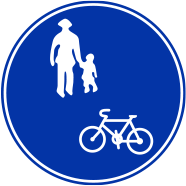
A sign “For standard bicycles and pedestrians only”
[Five Rules for Safe Bicycle Use / Article 63-4 of the Road Traffic Act]


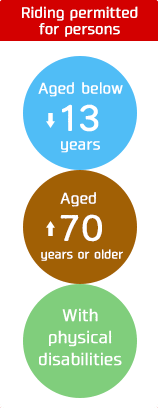
Riding on the sidewalk is permitted for standard bicycles ridden by children below the age of 13 years, by the elderly aged 70 years or older, and by persons with physical disabilities.

[Five Rules for Safe Bicycle Use / Article 63-4 of the Road Traffic Act]


Riding on the sidewalk is exceptionally permitted if there are compelling circumstances for the person riding the standard bicycle to ride on the sidewalk so as to ensure safe progress, such that it is difficult to ride on the left side of the roadway due to road construction or continuous parked vehicles, or because the traffic volume of automobiles is extremely high and the roadway is narrow, imposing a risk of collision with automobiles trying to overtake.
[Five Rules for Safe Bicycle Use / Article 63-4 of the Road Traffic Act]

In cases where bicycles are permitted on the sidewalk, bicycle riders must proceed at a reduced speed in the area from the center of the sidewalk toward the roadway if cycling on the sidewalk.
In addition, if the progress of the bicycle obstructs the progress of a pedestrian, the bicycle rider must yield the right of way to the pedestrian or come to a stop.
[Five Rules for Safe Bicycle Use / Article 63-4 of the Road Traffic Act]


Bicycles must follow traffic lights when proceeding on the road.
In particular, when crossing a road by proceeding on a pedestrian crossing, or when there is a sign “For pedestrians and bicycles only” on the pedestrian traffic lights, bicycle riders must follow the pedestrian traffic lights.
[Five Rules for Safe Bicycle Use / Article 7 of the Road Traffic Act]
At a place with a Stop sign, at crossings, etc., bicycle riders must come to a stop to check safety on both sides.
[Five Rules for Safe Bicycle Use / Article 43 of the Road Traffic Act]


When turning right, a bicycle rider must keep to the far left of the road in advance and proceed at a reduced speed along the edge of the intersection (a “hook turn”).
The procedure for a bicycle turning right is the same regardless of the size of an intersection (with or without a traffic light / wide or narrow road) or the shape of an intersection (T-shaped or cross-shaped intersection). Therefore, bicycle riders must make a hook turn at all intersections.
A bicycle rider failing to make a hook turn at an intersection with a traffic light is subject to a fine for running a red light (violation).
[Article 34 of the Road Traffic Act]
When a bicycle rider is going to cross the road, if there is a bicycle crossing lane nearby, the bicycle rider must cross the road along the lane.
If there is a bicycle crossing lane at an intersection, a bicycle rider must proceed along this lane.
[Article 63-6 and Article 63-7 of the Road Traffic Act]
A bicycle rider must proceed on the pedestrian crossing if there is no pedestrian on the crossing or if otherwise there is no risk of obstructing the progress of a pedestrian.
Because a pedestrian crossing is an area for pedestrians to cross, a bicycle rider must not ride a bicycle on a pedestrian crossing if there is a risk of obstructing the progress of a pedestrian.
A bicycle rider violating this rule is subject to a fine for violation of statutory prohibition on cutting across roads (violation).
[Article 25-2 of the Road Traffic Act]
Just like automobile drivers, bicycle riders must follow each sign/instruction.
Note: For other signs/instructions, please check the official information.
 No vehicles
No bicycles are permitted, either (except when there is an auxiliary sign “Bicycles excluded”).
No vehicles
No bicycles are permitted, either (except when there is an auxiliary sign “Bicycles excluded”). One way
No bicycles may proceed in the reverse direction either (except when there is an auxiliary sign “Bicycles excluded”).
One way
No bicycles may proceed in the reverse direction either (except when there is an auxiliary sign “Bicycles excluded”). Road closed to thru traffic
The road is closed to all vehicles, including bicycles.
Road closed to thru traffic
The road is closed to all vehicles, including bicycles.  Closed to bicycles and specified small motorized bicycles
The road is closed to bicycles.
Closed to bicycles and specified small motorized bicycles
The road is closed to bicycles. Slow down
Drive at a speed where you can stop immediately (bicycles included).
Slow down
Drive at a speed where you can stop immediately (bicycles included). Stop
Must come to a stop and check safety on both sides.
Stop
Must come to a stop and check safety on both sides. For pedestrians only
Only pedestrians may proceed on the road.
For pedestrians only
Only pedestrians may proceed on the road. For standard bicycles and pedestrians only
Only pedestrians and bicycles may proceed on the road.
For standard bicycles and pedestrians only
Only pedestrians and bicycles may proceed on the road. Bicycle crossing lane
An area used for bicycle crossing
Bicycle crossing lane
An area used for bicycle crossingBicycle riders must turn on bicycle lights at night (from sunset to sunrise). Ride a bicycle equipped with reflectors.
[Five Rules for Safe Bicycle Use / Article 52 of the Road Traffic Act]

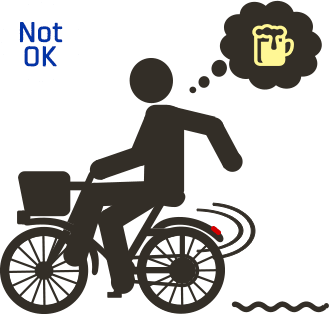
Just as automobiles, it is prohibited for any person to ride a bicycle after drinking. It is also prohibited for any person to provide a bicycle to a person who is drunk or to provide an alcoholic beverage to a person who is likely to ride a bicycle under the influence of alcohol.
[Five Rules for Safe Bicycle Use / Article 65-1 of the Road Traffic Act]
All users, regardless of age, riding a bicycle must strive to wear a riding helmet.
[Five Rules for Safe Bicycle Use / Article 63-11 of the Road Traffic Act]
In principle, only the bicycle rider may ride a bicycle, except in the following cases where infants may ride as passengers.
[Article 57 of the Road Traffic Act / Article 10 of the Tokyo Metropolitan Government Road Traffic Rules]

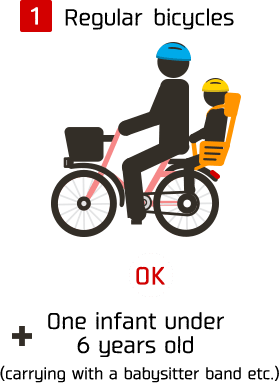
A bicycle rider aged 16 years or older may carry one person before the start of elementary school age in the infant seat.
Note: In addition, a bicycle rider aged 16 years or older may carry one infant on the back with a babysitter band.

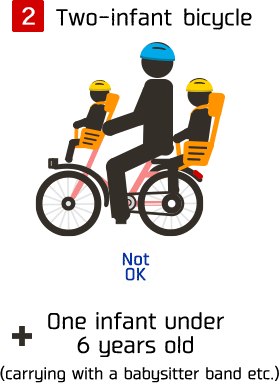
A bicycle rider aged 16 years or older may carry two persons before the start of elementary school age in the infant seats of a two-infant bicycle that satisfies specified safety standards.
Note: A bicycle rider must not carry an infant on the back with a babysitter band.



Bicycle riders repeating specified dangerous conducts twice or more within three years (“malicious bicycle riders”) must undergo training in a specified period within three months under the order of the Public Safety Commission.
(June 1, 2015, enforced on July 1, 2023)
[Article 108-2, Article 108-3-5, and Article 120 of the Road Traffic Act / Article 41-3 of the Order for Enforcement of the Road Traffic Act]



Bicycle accidents can result not only in personal injury, but also in serious injury to the other party or claim for expensive compensation. In addition, many municipalities, including the Tokyo Metropolitan Government, have stipulated the obligation to purchase bicycle insurance by ordinances. There are cases where duty to strive is stipulated in regions where the obligation is not stipulated.
Furthermore, starting April 2026, the blue ticket (traffic violation notice system) is introduced for bicycles, promoting stringent enforcement on traffic violations. Against this backdrop, it is becoming increasingly important to purchase bicycle insurance as part of safety measures.
Insurance that provides coverage in the event a bicycle rider causes injury to another person or damage to another person’s property, resulting in a liability claim (these may also be covered under the “personal liability coverage” in fire or automobile insurance policies)
Insurance that pays out when a bicycle rider is injured and needs medical expenses or other costs
Insurance included with the TS Mark affixed to bicycles that have been inspected and serviced at a certified bicycle safety maintenance shop
*Valid for one year